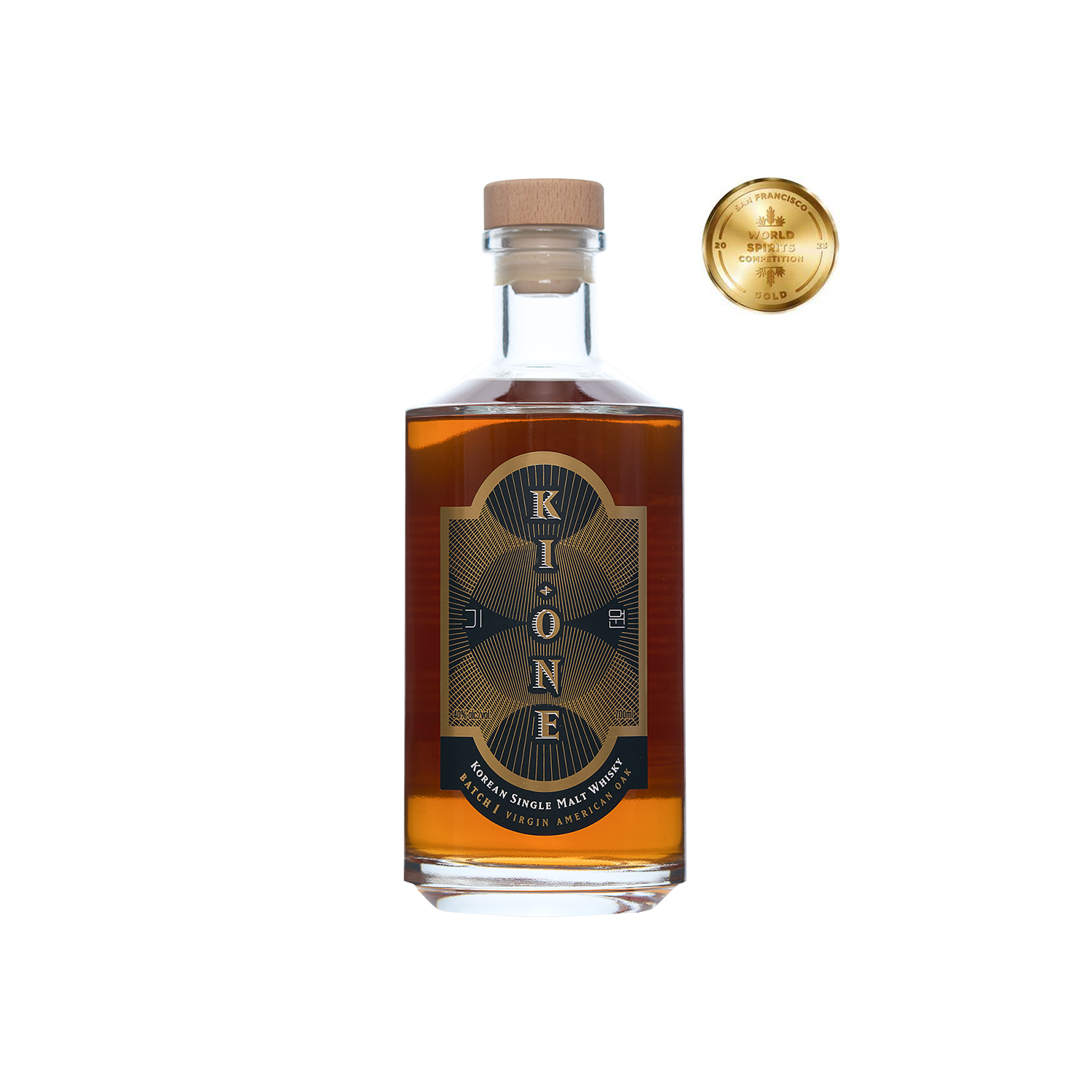
Bourbon Whiskey
The bold and sweet American whiskey made from corn
What is Bourbon Whiskey?
Bourbon Whiskey is a 'distinctive product of the United States,' officially recognized by Congress in 1964 as America’s Native Spirit. It must be produced in the USA from a grain mash of at least 51% corn and aged in new, charred American oak containers. Unlike Scotch or Canadian whisky, Bourbon strictly prohibits any additives like coloring or flavoring, ensuring a pure and bold profile of natural vanilla and caramel.
History & Origin
The origins of Bourbon date back to the late 18th century with settlers in Kentucky. Legend credits Reverend Elijah Craig as the first to age spirit in charred oak barrels. Its name was popularized as it was shipped down the Mississippi River to 'Bourbon Street' in New Orleans. The 1897 Bottled-in-Bond Act was a historic milestone that protected consumers from low-quality spirits and established the rigorous standards that make Bourbon one of the world's most trusted whiskey styles today.
Types & Classification
What is Bourbon Whiskey?
Produced in the USA; mash bill of 51%+ corn; distilled at no more than 160 proof (80% ABV); entered into new charred oak at no more than 125 proof (62.5% ABV); no additives (color/flavor) allowed; bottled at 80 proof (40% ABV) or higher.Bourbon gains its amber hue and rich flavor solely through interaction with new oak. A higher corn percentage results in an oily, sweet texture. Due to the warmer climate in the US, the 'Angel's Share' (evaporation) is much higher than in Scotland, leading to a more rapid and intense maturation process.
What is Straight Bourbon?
Meets all Bourbon requirements + aged for at least 2 years; no coloring or flavoring added; must include an age statement if aged less than 4 years.The gold standard for reliability. At least 2 years of aging rounds off the edges, developing complex notes of caramel, toffee, and leather. If no age is stated, the Straight Bourbon is guaranteed to be at least 4 years old.
What is Bottled-in-Bond (BiB)?
Product of one distillery + one distilling season + aged in a federally bonded warehouse for at least 4 years + bottled at exactly 100 proof (50% ABV).Often called the 'Gold Standard,' this category legally guarantees transparency. The 100-proof strength provides a robust body and is the ideal benchmark for users searching for the authentic 'Bourbon Proof' experience.
What is Single Barrel?
Bottled from a individual, unique barrel without blending.Maximizes the specific character of a single cask, influenced by its location in the rickhouse (high heat/evaporation at the top), wood variance, and entry proof. Ratios of vanilla, spice, and fruit can vary significantly even under the same label.
What is Small Batch?
No legal definition; generally refers to blending a limited number of selected barrels.Aims to maintain a house style while allowing for subtle batch nuances. It provides a more consistent balance of sweetness and spice compared to single barrel offerings.
What is Cask Strength / Barrel Proof?
Bottled at the proof directly from the barrel (or with minimal dilution).Features intense alcohol volume and concentrated flavors of oak, baking spices, and candied fruit. Adding a few drops of water often opens up hidden notes of vanilla and caramel.
What is Wheated Bourbon?
Uses wheat as the secondary 'flavor grain' instead of rye.Reduces the peppery/herbal spice of rye, emphasizing soft sweetness like bread, biscuits, honey, and toffee. Known for a rounder, creamier mouthfeel, making it highly approachable for beginners.
What is High-Rye Bourbon?
Maintains 51% corn but features a significantly higher proportion of rye.Brings forward 'baking spices' like black pepper, cinnamon, and cloves along with dry herbal tones. The spicy tension contrasts the corn sweetness, pairing exceptionally well with bitters and citrus in cocktails.
What is Cask-Finished Bourbon?
Bourbon that has undergone additional maturation (finishing) in a different type of cask after initial aging in new charred oak.Layers secondary flavors (from wine, rum, sherry, or port casks) onto the traditional bourbon base. It amplifies sweetness and fruitiness, though balancing the finish with the original oak character is key.
Sensory Metrics
- ABV/Proof40~65% ABV (80~130 proof)
What is Proof / Alcohol Volume?
The American 'Proof' unit is exactly double the ABV percentage. 80 proof is the legal minimum, while enthusiasts often seek 100 proof (50% ABV) or higher for more concentrated oak spices and a bolder mouthfeel.
- Mash Bill (Corn %)51~80% (Typical Range)
What is Corn Proportion?
Higher corn content bolsters sweet, round tones like honey and cornbread. Balance with oak tannins and spice is critical to prevent cloying sweetness.
- Rye vs WheatRye High / Balanced / Wheat Dominant
What is Secondary Grain Character?
Rye provides a sharp outline with pepper and herbs; wheat creates a soft texture with biscuit and toffee notes. This grain choice dictates the spice intensity of the finish.
- Char Level (#1 to #4)#3 to #4 (Commercial Standard)
What is Barrel Char Level?
Deeper char levels increase vanilla (from lignin), caramel (from sugar breakdown), and smoky/toasted notes. The char also acts as a filter to mellow harsh elements.
- Age (Years)2~12+ years
What is Age Statement?
Increased age brings more wood-derived tannins, leather, and tobacco. However, over-aging can lead to dry wood bitterness, depending on the rickhouse microclimate.
- Entry Proof50~62.5% ABV (Max 62.5%)
What is Barrel Entry Proof?
The proof at which the spirit enters the barrel affects the ratio of extracted components. Lower entry proofs can yield a sweeter, oilier texture, while higher proofs may sharpen spice and oak notes.
Flavor Profile
Core Ingredients
Corn
The legal and sensory heart of Bourbon. It forms a sweet base of honey and cornbread, acting as a canvas for the vanilla and toffee notes from the oak.
Rye or Wheat
Rye provides structure through pepper and cloves; wheat enhances soft sweetness and creamy texture. This is the primary variable for a brand's house style.
Malted Barley
Provides amylase enzymes to convert starches into fermentable sugars. It also adds subtle nutty and biscuity nuances.
Yeast Strain
Dictates the direction of esters and higher alcohols, producing fruity (apple/cherry), floral, or spicy notes.
New Charred American Oak
The source of most bourbon flavors. Breakdown of wood components creates vanilla, caramel, coconut (oak lactones), and smoke.
Sour Mash (Backset)
A portion of the previous distillation residue is reused to stabilize pH and prevent microbial contamination, ensuring consistency across batches.
Production Method
Grist Milling
Grains are ground to a specific particle size to optimize extraction efficiency. A balance is needed to prevent high viscosity and pumping issues.
Gelatinization
Corn is cooked at high temperatures to gelatinize starch, followed by step-cooling before adding other grains and malt.
Enzymatic Saccharification
Malt enzymes convert starches into sugars. The sugar composition influences the resulting fermentation products (esters/aldehydes).
Sour Mash Process
The backset stabilizes pH, maintaining a consistent fermentation environment and the distillery's unique profile over time.
Fermentation (3–7 days)
Yeast converts sugars into alcohol and aromatic compounds. Careful management of temperature and time is key to controlling fruitiness vs. harshness.
Continuous Column Still + Doubler/Thumper
Continuous distillation ensures efficiency, while the doubler/thumper provides a secondary refinement. Distilling below 160 proof preserves grain character.
Entry Proof & Barreling
Spirit is diluted to no more than 62.5% ABV and put into new charred oak. This 'entry proof' is a critical lever for flavor balance and texture.
Rickhouse Maturation
Temperature fluctuations cause the whiskey to move in and out of the wood, gaining vanilla, caramel, and spice while oxidizing for complexity.
Blending & Barrel Selection
Barrels are blended for small batches or a single stand-out cask is selected for bottling to meet specific flavor goals.
Proofing & Filtration
The whiskey is proofed with water (unless barrel proof) and filtered. Non-chill filtration is often preferred for retaining full texture and flavor oils.
Serving Guidelines
Optimal Temperatures:
Best for experiencing vivid vanilla, caramel, and oak spices with a long, viscous finish.
A few drops of water break surface tension, allowing hidden esters and floral/fruit notes to bloom.
Reduces alcohol bite and highlights the round sweetness of the corn for a smooth, chilled experience.
Recommended Methods:
The standard way to appreciate the heavy body and direct oak profile without dilution or chilling.
Recommended for high-proof or barrel-proof expressions to release complex aromas.
The backbone of classics like the Old Fashioned, Manhattan, or Whiskey Sour. Also excellent in highballs where smokiness meets carbonation.
Serving over a large, clear ice sphere mellows the alcohol's edge, transitioning the drink into a softer, sweeter profile.
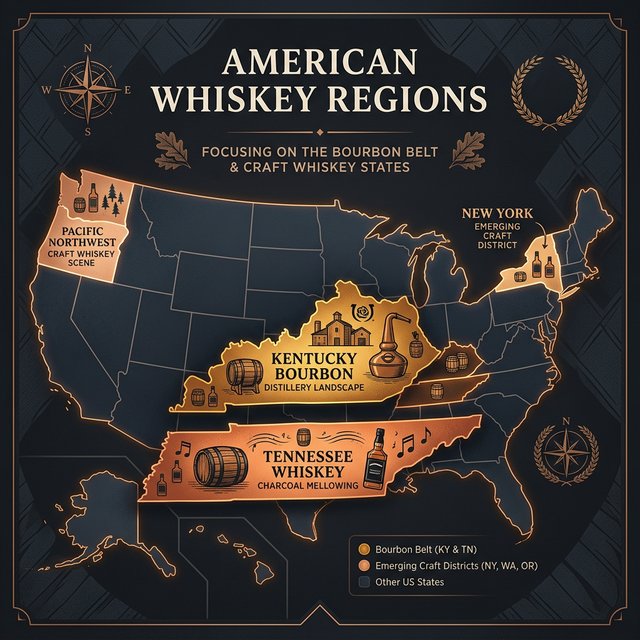
🗺️ Regional Deep Dive
🗺️ Explore American Whiskey Regions (Kentucky, Tennessee, Rye) →
Food Pairing
Frequently Asked Questions
Q.How many bottles of bourbon per barrel?
A.A standard 53-gallon (about 200 liters) bourbon barrel typically yields around 150 to 200 bottles. This number varies depending on the 'Angel's Share'—the amount of liquid that naturally evaporates during the multi-year aging process.
Q.Does bourbon have sugar?
A.No, bourbon does not contain any added sugar. By law, bourbon production strictly prohibits the addition of flavoring, coloring, or sweetening additives. The sweet vanilla and caramel notes you taste come entirely from the natural wood sugars extracted from the newly charred oak barrels during maturation.
Q.What are the strict bourbon requirements?
A.To legally be called bourbon, the whiskey must be produced in the United States, made from a grain mixture that is at least 51% corn, and aged in new, charred oak containers. Furthermore, it must be distilled to no more than 160 proof, entered into the barrel at no more than 125 proof, and bottled at no less than 80 proof (40% ABV).